Hypothesis:
It is hypothesized that considering that zinnia's prefer more acidic soil types, the neutral and acidic plants will do the best. The basic plants will probably not do as well and may even die.
Materials:
Zinnia seeds (25)
3 lemons
water
30 mL soap
pH 9 buffer
soil
source of light
beakers
Procedure:
1. Plant seeds in 3 separate, equal sized pots. Use only dirt in each pot. Make sure to put and equal amount of seeds in each pot.
2. Once a week, water each plant 10 mL with it's respective water type. The mixtures are as follows:
Acidic - 20mL lemon juice and 20mL water mixed together
Basic - 10mL soap and 30 mL water mixed together
Neutral - 40mL water
The mixtures can be adjusted to make more liquid, however the ratio must stay the same.
3. Each week record the growth of each plant in a journal.
Discussion:
If the experiment were to be done again, a pH 9 buffer would be used in place of the soap. Soap would not be used as it is thought to have a chemical in it responsible for directly killing the plants. Another good amendment to the experiment would be to make sure there are extra seeds in case a replanting must occur.
Conclusion:
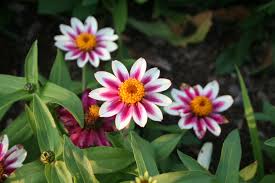
It was found that the hypothesis was correct; the Zahara Starlight Rose Zinnia's prefer neutral to acidic pH levels in the soil as opposed to basic levels. It was also found that the soap we used to create the basic pH had a chemical in it that killed both the Zinnias as wells as the kohlrabi. The kohlrabi did not die due to the pH 9 buffer, so it would be ideal to test that on the Zinnias as well.
Tuesday, 11 June 2013

Sunday, 26 May 2013
Our Zinnias Part Two
We observed significant changes after we started the acidic and basic treatments to our zinnias. In about a day we had noticed that the basic group was looking unhealthy and not very strong at all.
It was surprising how fast the effect of the basic treatment was on the plant. Here it is just a few days after the first treatment.
 |
| The Zinnias immediately after treatment |
 |
| The acidic group a few days after treatment |
 |
| The basic group few days after first treatment |
 |
| The neutral group |
These were the results we had expected, just not as quick as they had happened. The neutral and acidic groups seem to be healthy and have grown significantly.
After a week the results were much more noticeable, especially the basic group.
 |
| The basic group over a week after treatment |
 |
| The acidic group over a week after treatment |
 |
| The neutral group over a week after the treatments |
It is quite obvious that the basic treatment killed the plants. The acidic treatment hasn't harmed the plants substantially, however, they do look more yellow and not as strong as the control group. We have planted kohlrabi seeds to retest the basic treatment on them.
Friday, 24 May 2013
Stephen Jay Gould
Name: Stephen Jay Gould
Birth: September 10, 1941 in Bayside, New York, United States
Death: May 20, 2002 in Manhatten, New York, United States for the cancer
Nationalism: American
Field: Paleontology, Evolutionaty Biology, History of science
Marriage: Twice - Deborah Lee on October 3, 1965
- Rhonda Roland Shearer in 1995
Kin - 2 children from first wife(Jesse and Ethan)
- 2 children from second wife (Jade and Lodon Allen)
Institutions: Harvard University, New York University, American Museum of Natural History
Contribution: Gould's contribution to the science is revising the theory of evolution to the today's version. He developed the theory of punctuated equilibrium in which evolutionary change occurs relatively rapidly, alternating with longer periods of relative evolutionary stability, and the concept of pluralism.
Book: The Mismeasure of Man(1981), Wonderful Life(1989), Full House(1996), and etc

Birth: September 10, 1941 in Bayside, New York, United States
Death: May 20, 2002 in Manhatten, New York, United States for the cancer
Nationalism: American
Field: Paleontology, Evolutionaty Biology, History of science
Marriage: Twice - Deborah Lee on October 3, 1965
- Rhonda Roland Shearer in 1995
Kin - 2 children from first wife(Jesse and Ethan)
- 2 children from second wife (Jade and Lodon Allen)
Institutions: Harvard University, New York University, American Museum of Natural History
Contribution: Gould's contribution to the science is revising the theory of evolution to the today's version. He developed the theory of punctuated equilibrium in which evolutionary change occurs relatively rapidly, alternating with longer periods of relative evolutionary stability, and the concept of pluralism.
Book: The Mismeasure of Man(1981), Wonderful Life(1989), Full House(1996), and etc
Sunday, 12 May 2013
Anatomy of Zinnia
Anatomy of Zinnia flower


Pollen of a Zinnia

Petals of Zinnia flower

Composites of Zinnia
Anatomy of stem


The mature flower has both stamen and ovary. Stamen is the male organ used to produce pollen. The ovary is the female organ were the fertilization happens.
Stamens consist of two parts: a stalk called a filament, topped by an anther where pollen is produced by meiosis and eventually dispersed.
Ovules give rise to egg cells.
The sticky tip of the pistil, the stigma, is the receptor of pollen. The supportive stalk, the style, becomes the pathway for pollen tubes to grow from pollen grains adhering to the stigma.
Exception ( has only one gender flower )
The staminate is the male flower while the pistillate is the female flower. An example of an only sex flower is the Catkins of the willow tree. Only one gender flower can not do the self-fertilization. It has to do cross-fertilization with other factors' helps such as bee, butterfly, wind, and birds.
 Male Catkin
 Female Catkin
Pollen of a Zinnia
Petals of Zinnia flower
Composites of Zinnia
Anatomy of stem
General Flower ( has both genders in a flower )
The mature flower has both stamen and ovary. Stamen is the male organ used to produce pollen. The ovary is the female organ were the fertilization happens.
Stamens consist of two parts: a stalk called a filament, topped by an anther where pollen is produced by meiosis and eventually dispersed.
Ovules give rise to egg cells.
The sticky tip of the pistil, the stigma, is the receptor of pollen. The supportive stalk, the style, becomes the pathway for pollen tubes to grow from pollen grains adhering to the stigma.
Exception ( has only one gender flower )
The staminate is the male flower while the pistillate is the female flower. An example of an only sex flower is the Catkins of the willow tree. Only one gender flower can not do the self-fertilization. It has to do cross-fertilization with other factors' helps such as bee, butterfly, wind, and birds.
Male Catkin Female CatkinFriday, 10 May 2013
Day 21
Today we started the treatment on our plants. We watered each sprouted plant with 10mL of water, we watered the acid group with a solution of half lemon juice to half water. The basic group was watered with a solution of 20% soap and 80% water. The neutral was watered with plain tap water. We measured our plants to compare the heights now and at the end. The measurements before the experiment were as follows:
Acid- 2.0cm (shortest) & 5.0cm (tallest)
Basic- 3.0cm (shortest) & 6.0cm (tallest)
Neutral- 1.0cm (shortest) & 5.5cm (tallest)
The average height was 3.75cm.
In a week we will measure our plants again to see if anything has changed since the treatment began.
Acid- 2.0cm (shortest) & 5.0cm (tallest)
Basic- 3.0cm (shortest) & 6.0cm (tallest)
Neutral- 1.0cm (shortest) & 5.5cm (tallest)
The average height was 3.75cm.
In a week we will measure our plants again to see if anything has changed since the treatment began.
Sunday, 5 May 2013


Thursday, 2 May 2013
Growing Zinnia
- Time: takes approximately five to seven days
- Temperature: 68 to 72°F (20 to 22°C)
Growth
- Transplant: when there are at least two sets of true leaves
- Space: space 6-12 inches apart
- Light: full sun
- Soil: PH 5.5 - 7.0, fertile
- Temperature: 60-65° days/55-60° nights
- Water: normal
- Blossom season: spring to summer
Common Problems
- Insects:Monitor for Aphids early in production, and
Thrips during flowering
- Disease: Avoid high humidity or condensation because these conditions are favorable for Botrytis and Powdery Mildew diseases.


Subscribe to:
Posts (Atom)